

// language models
A LLM (Large Language Model) is a neural network trained on enormous textual corpora. It does not “understand” in the human sense: it predicts the next token with a learned probability.
The pipeline
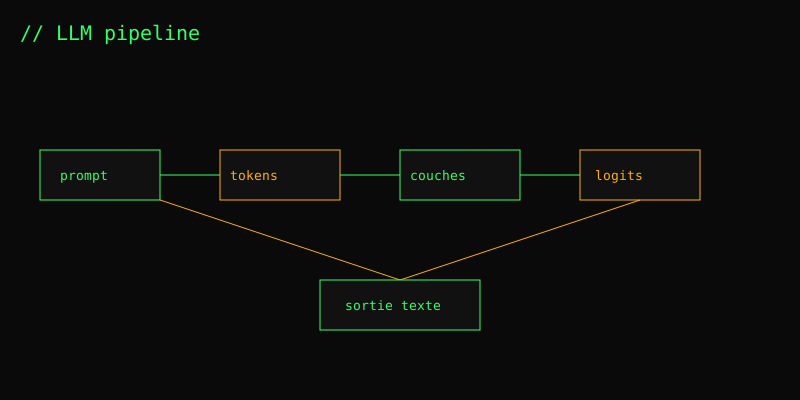
- Prompt — input text.
- Tokenization — split into units.
- Layers — attention-based transformers.
- Logits — scores for the next token.
The diagram illustrates this left-to-right flow, then the output loop. Open-weights models (Llama, Mistral, Qwen) enable local deployment with no cloud dependency — an asset for privacy.
Understanding this mechanism avoids illusions: the model hallucinates when probability dictates it.